




SKA Telescope Specifications
The SKA design
The SKA consists of two telescopes: SKA-Low and SKA-Mid. SKA-Low covers the frequencies 50-350 MHz, using log-periodic dipole antennas grouped into stations (aperture arrays), and SKA-Mid covers 0.35-15.4 GHz, using offset Gregorian dishes.
Each telescope consists of a dense core of ~1-2 km in size containing ~50% of stations/dishes, with the remaining stations/dishes placed logarithmically along 3 spiral arms. The dense core provides excellent sensitivity to extended regions of low brightness and for pulsar and transient observations, while the 3-arm spiral provides a scale-free distribution of baselines, and therefore uniform sensitivity over a range of angular scales and excellent (u,v) coverage, for both snapshot and long integration observations. The station/dish locations are fixed and so are not re-configurable.
Current status
The SKA telescopes are currently under construction. The current construction phase, expected to be completed in 2029 for SKA-Low and 2031 for SKA-Mid, will deliver a substantial part of the planned scope of both instruments. A new funding window, commencing in 2030, is expected to support further expansion towards the full scope of the telescopes. Telescope capabilities will be commissioned, verified and made available for regular observations (Cycle 0) starting from 2030 and 2032 for SKA-Low and SKA-Mid, respectively.
The details of the overall system design of the SKA telescopes is captured in the Design Baseline Description, while the required science performance is captured in the Level 0 Science Requirements.
The staged delivery is fully described in the Staged delivery memo.
Array Layouts
SKA-Low
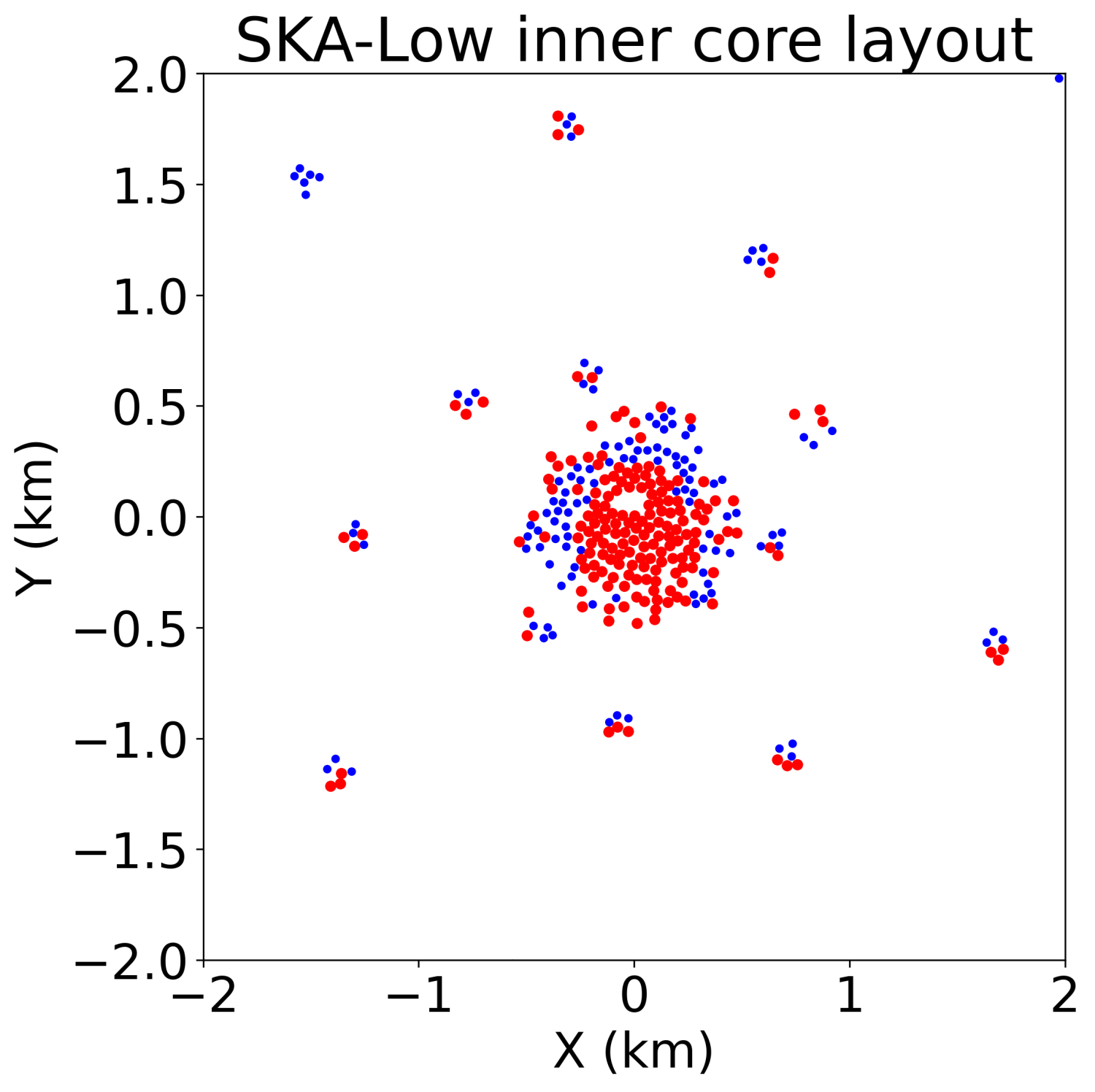
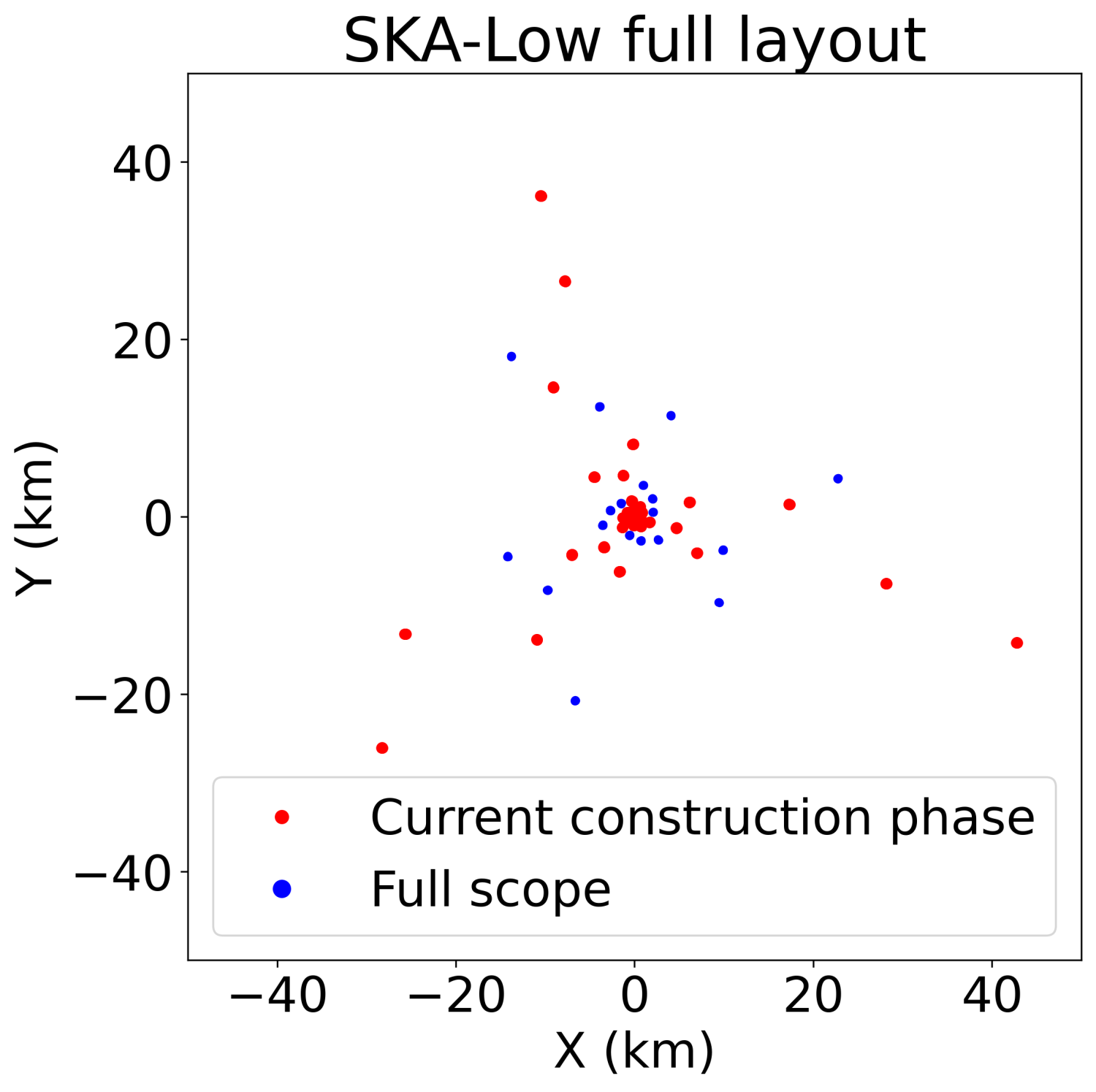
SKA-Low is located in the Murchison Radio-Astronomy Observatory (Inyarrimanha Ilgari Bundara), Western Australia. It will ultimately consist of 131,072 log-periodic dipole antennas distributed across 512 aperture array stations of 256 antennas each, with around 50% of the stations located within a 1 km diameter core and the remaining stations organised in clusters of 6 stations spaced logarithmically on three spiral arms. The maximum baseline length will be 74 km. By the end of the current construction phase, 257 stations will be delivered, of which 149 in the core and 108 on the three spiral arms, for a maximum baseline of 74 km.

SKA-Mid
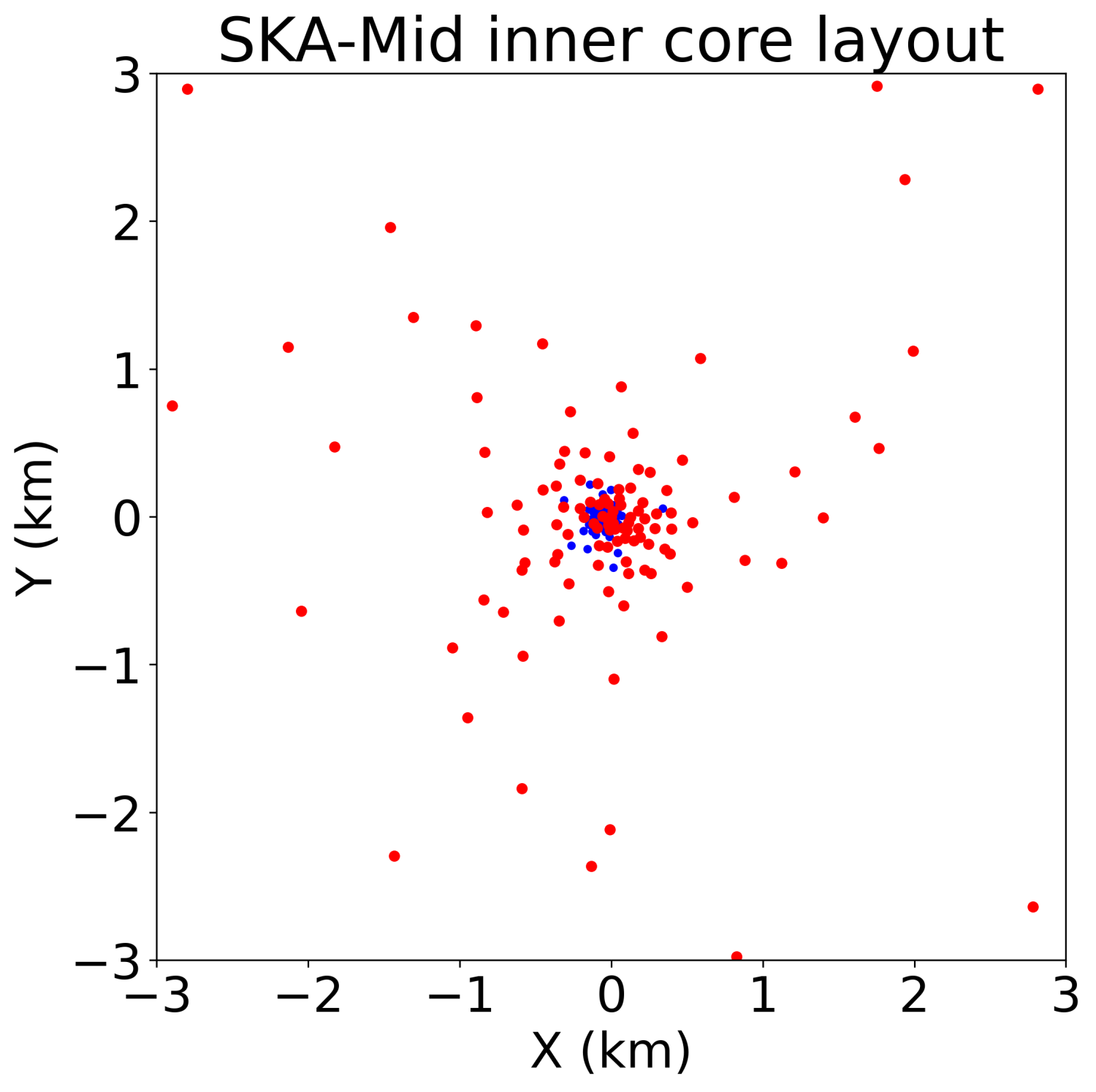
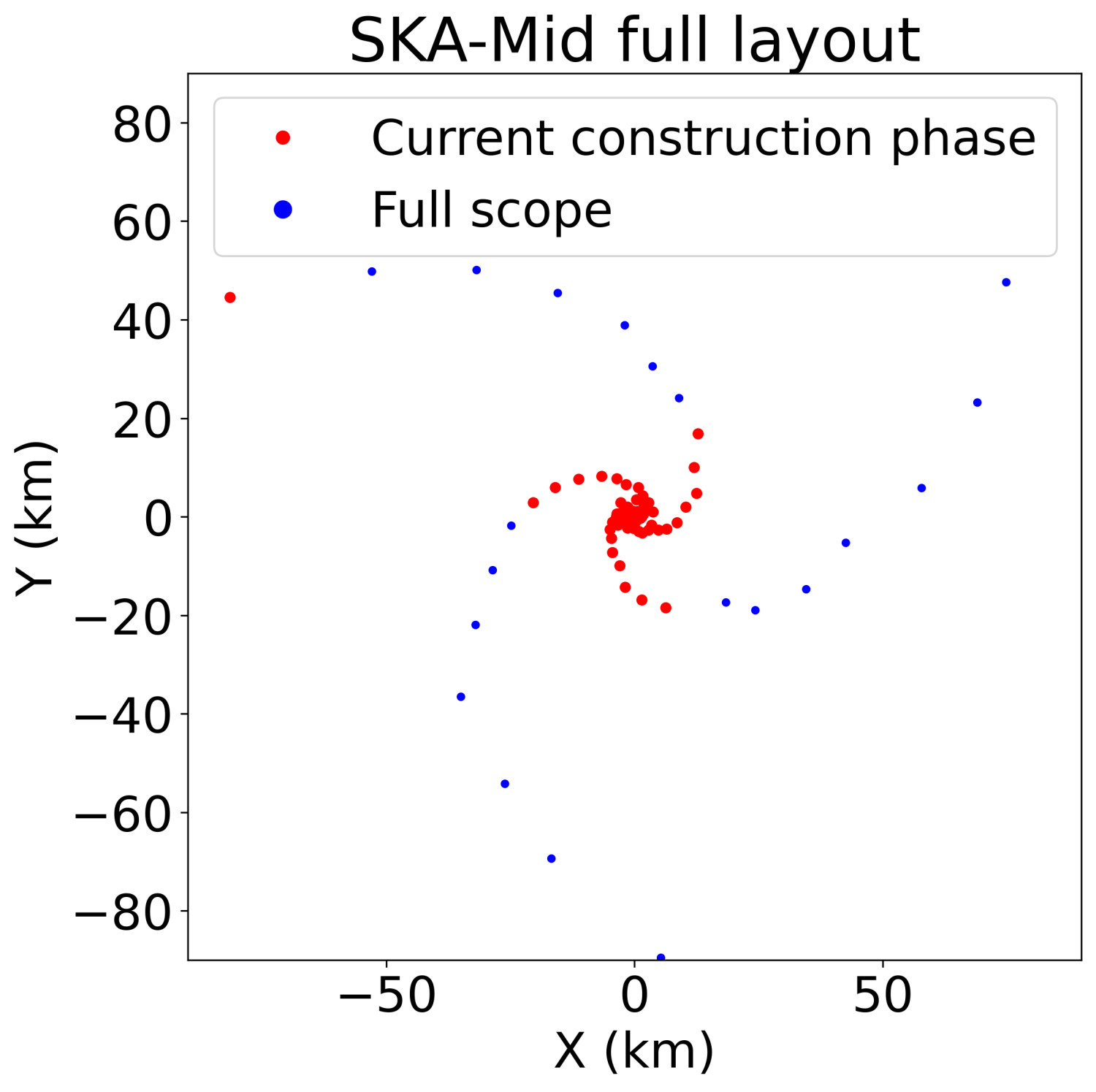
SKA-Mid is located at the Karoo Radio Astronomy Reserve in the Northern Cape of South Africa. At full scope, it will comprise 133 15-m SKA dishes and the 64 13.5-m dishes of MeerKAT. Approximately 50% of the dishes will form the core, randomly distributed within a 2-km diameter region. The remaining dishes will be distributed logarithmically along three spiral arms, providing baselines of up to 160 km.
The current construction phase will deliver 80 15-m SKA dishes and the integration of the 64 MeerKAT dishes. This configuration will provide an effective maximum baseline of 36 km across the three spiral arms, with a single baseline extending to 105 km.
Frequency Bands
SKA-Low has a single frequency band, while SKA-Mid design baseline includes 4 Bands: Bands1, 2, 5a, 5b.
| Telescope | Band | Frequency Range (MHz) | Available Bandwidth (MHz) |
|---|---|---|---|
| SKA1-Low | N/A | 50 - 350 | 300 |
| SKA1-Mid | 1 | 350 - 1050 | 700 |
| 2 | 950 - 1760 | 810 | |
| 5a | 4600 - 8500 | 3900 | |
| 5b | 8300 - 15400 | 2 x 2500 |
Bands 3 and 4, covering 1650 - 3050 MHz and 2800 - 5180 MHz, respectively, could be delivered as an upgrade with the respect to the Baseline design. Further, SKA-Mid is designed to work up to frequencies of 20 GHz, with a requirement on aperture efficiency at that frequency. The actual performance of the Mid dishes at 20 GHz remains to be determined (surface, pointing). If the dishes perform as expected, then a potential upgrade is the deployment of a frequency band for frequencies > 15 GHz ("Band 6"), as part of a future Observatory Development Programme. The initial science case for observations at > 15 GHz can be found here. The useful highest operating frequency is still to be determined.
SKA's science portfolio
The SKA telescopes will be highly capable and versatile instruments from the outset, enabling transformational science across a broad range of scientific areas.
- Sun, Earth and Planets: Exploring Solar Activity, Heliospheric Processes, and Planetary Systems
- Formation and Evolution of Stars: From Molecular Clouds and Protoplanetary Disks to Supernova Remnants and Magnetars
- From the Milky Way to Distant Galaxies: Structure of Galaxies, Interstellar and Circumgalactic Medium, Magnetic Fields, Star Formation, Active Galactic Nuclei and Cosmic Evolution
- The Cosmos: Cosmology, the High-Redshift Universe, Large-Scale Structure and Fundamental Physics
- The Extreme Universe: Pulsars, Compact Objects, Transient Phenomena, High-Energy Particle Astrophysics, and Multi-Messenger Astrophysics
The latest census of science cases developed by the SKA community is presented in our most recent science book, Advancing Astrophysics with the SKA II.
More information about the scientific vision of our community can be found in the Science Working Groups page
The full SKA vision
While the current focus is to deliver the SKA as per the design baseline described above, the SKAO keeps the vision of a much larger SKA alive. Such vision is sometimes referred to as SKA2 (i.e. the second phase of the SKA project), consisting in increasing both the number of receptors (stations/dishes) and baseline lengths for each telescope (extending to other African countries in the case of SKA-Mid), and perhaps the addition of other telescopes (survey dish array, mid-frequency aperture array). This major expansion is in addition to upgrades envisioned as part of the Observatory Development Program, which will primarily be aimed at improving the performance of the SKA as built.
While the actual scope of SKA2 is not fully defined, the aspirations include:
- 4-10 x SKA sensitivity in the frequency range of 50 – 350 MHz
- 10 x SKA sensitivity in the frequency range of 350 MHz – 15 GHz (including full frequency coverage)
- 20 x SKA Field-of-View in the frequency range of 350 MHz – 1.5 GHz
- Increased Field-of-View at frequencies > 1.5 GHz
- Increase in the high frequency range of SKA-Mid to 25 GHz or higher
- 20 x SKA maximum angular resolution