





Team SKA: Dr Stefan Ohm
DZA is also part of another story: a major science infrastructure established in a former lignite mining region on the border between Germany and Poland. Its role is to support structural change in the region by making Görlitz a home of cutting-edge science, attracting economic investment, and connecting with communities that have so far not had a chance to interact with “big science” before. Dr Stefan Ohm is DZA’s Head of Regional Networking and Science Communication, and is shaping the organisation’s collaborations with communities locally and internationally. An experienced astrophysicist, he’s now co-leading a training programme for astronomy educators in Ukraine. We spoke to Stefan about his international career, his vision for science engagement, and the importance of scientists being in touch with communities.
Let’s start with your early life, Stefan – where did you grow up?
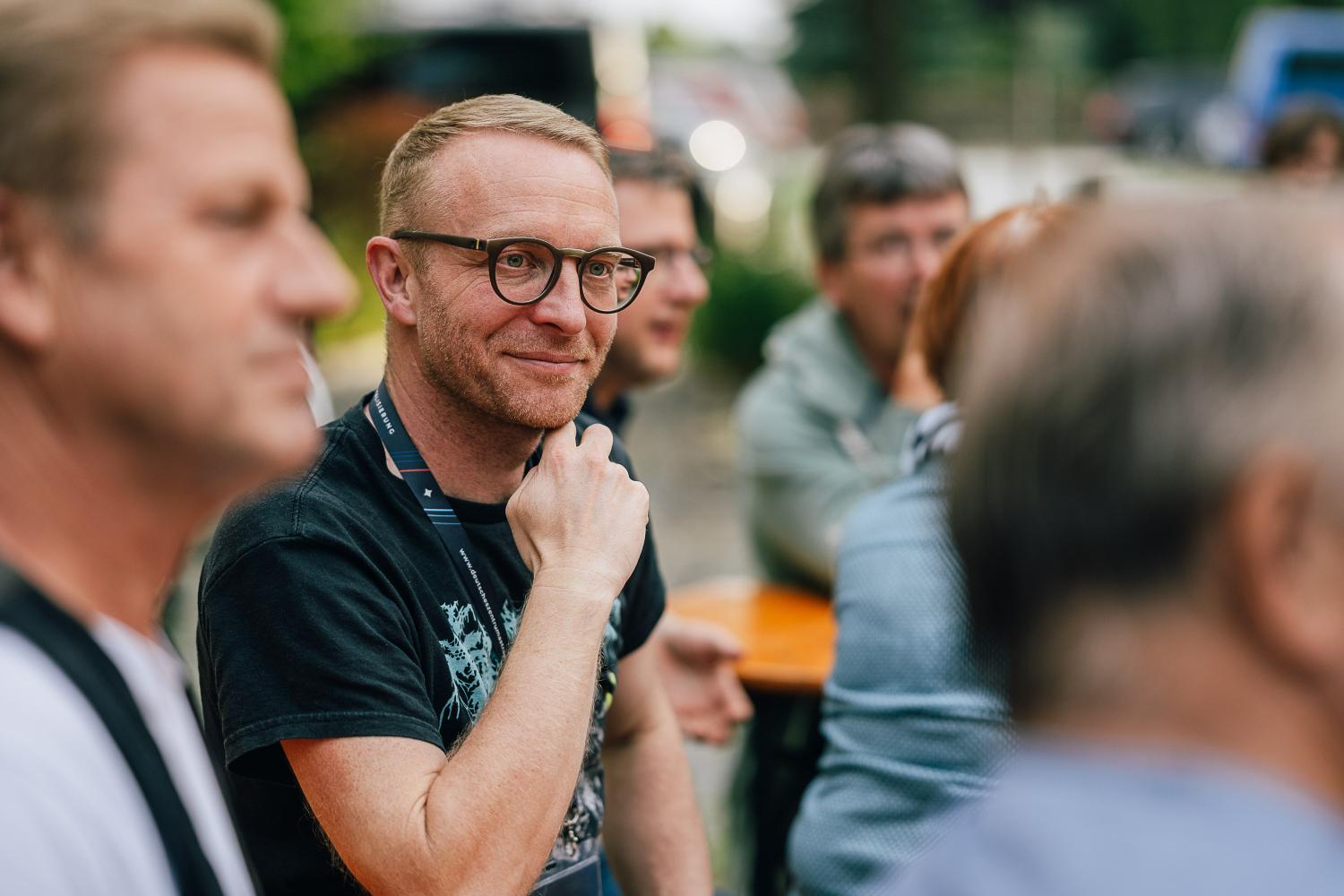
What was your childhood like? If you look at the German map and you point your finger at the middle, that’s where I grew up, in a small town in a rural part of Thuringia, in what was then East Germany. It was a very nice childhood, with lots of time outside, lots of friends. My parents always supported me and knew that education was important to be successful later in life, so I went to the gymnasium [secondary school which prepares students for university] and focused on maths and physics, although I also enjoyed architecture and history, and liked playing football.
What did your parents do?
My mother used to work in the finance department of an old mining company, but after the [Berlin] wall came down it went bankrupt, as did so many other industries and companies in East Germany. My father also lost his industrial job, so my family went through this disruption and had to reorient while I was eight years old, and my brother was six. My parents had been studying through a distance-learning university while they were working and raising two kids, but then the wall came down and their grades and their certificates were no longer really worth much.
So the early 90s were really, really hard, but my parents managed, they got new jobs, and I became the first in my family to go away to university. It was good of course that Germany was reunited, but there were disruptions that followed for 20 or 30 years, and that connects to what I’m doing right now.
What sparked your interest in astronomy, and how did you decide that it was what you wanted to do professionally?
I was always curious and interested in the big questions: where we come from, where we are going, anything that was far away and hard to reach sparked my interest. One day in school, I found an old CD from the University of Heidelberg about studying physics and astronomy. That’s when I decided I will go and study astronomy in Heidelberg. I didn’t even ask myself where else I wanted to go! I was 15, and it was kind of set in stone.
It did not come out of nowhere. The first German in space was from Saxony in eastern Germany, so astronomy and space were always very prominent in culture and in education. In every school astronomy was a standalone subject, so that was the foundation for me - without that I would probably never have picked up the CD.
So you studied in Germany and then abroad with postdoctoral positions in the UK – how did that international experience shape your outlook, and your career?
One of the really great things that you can do in science is traveling. You not only get to learn the mysteries of the Universe, you also get to learn new cultures and meet new people.
After my PhD, I got a Humboldt fellowship to go to the UK, first to Leeds and then to Leicester, to do gamma-ray astronomy and astro-particle physics. In the end I stayed three years in the UK. It improved my English a lot, and it was great to see another scientific system. Being exposed to so many different people with different backgrounds and expertise also convinced me even more that you need this to understand your own role better.
You mentioned your research specialism is in high-energy astrophysics, particularly gamma-ray astronomy. What fascinates you about that?
I entered gamma-ray astronomy the way I entered some other things as well: luck, coincidence and curiosity. Originally, I wanted to study cosmology, but all the spots were taken so I looked at the other groups. Gamma-ray astronomy was a new field which was just starting to take off around 2005 with the H.E.S.S., MAGIC and VERITAS telescopes going online. As the H.E.S.S. experiment, which I joined in 2006, wasn’t a huge collaboration or consortium, I was exposed to the instruments and to the data, which was the great appeal for me. Then of course, the science: it’s black holes and neutron stars, and being able to discover new things in a small team.
Do you have a favourite among your team’s discoveries?
Several – one of them was working on an analysis algorithm that helped to discover very-high-energy gamma rays from the NGC 253 starburst galaxy as part of the H.E.S.S. collaboration [a gamma-ray observatory based in Namibia]. I remember to this day meeting in a small group to decide what to do when we saw a hint of a signal. It was decided we had to go all in and dedicate 150 hours, or 10% of the observing time for the full year, just on this object. I was just a PhD student thinking “oh God, really?!” But we went for the risk and we got the reward.
Your H.E.S.S. work took you to Namibia where the telescopes are located – tell us about that.
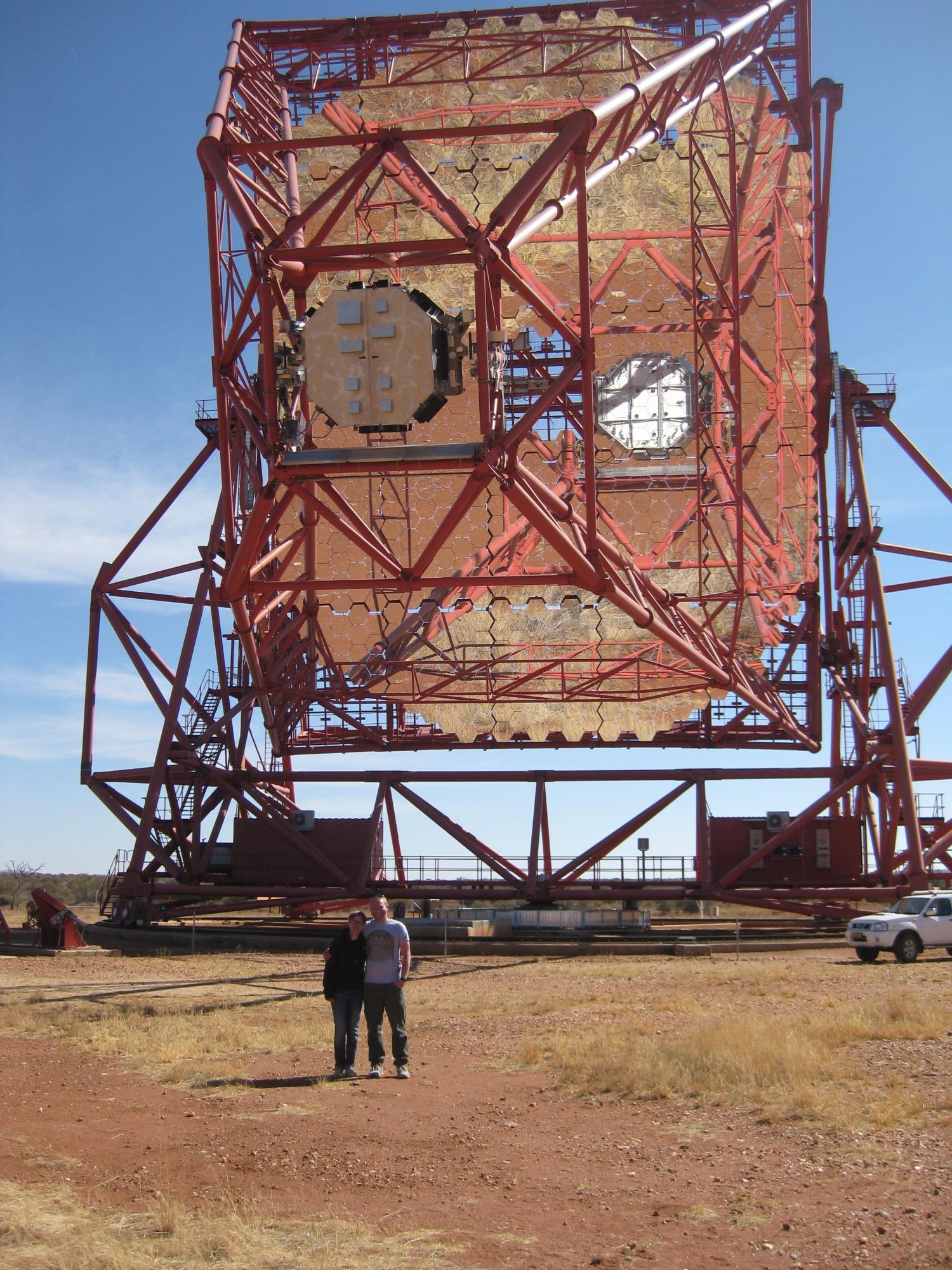
I went to Namibia several times during my PhD because as early career scientists we took observing shifts for three weeks at a time at the telescope site, in the middle of nowhere. Some people struggled with the remoteness, but this was my dream: space, animals, silence, nature and telescopes to play around with.
We had open days where local kids would visit, and in the later stages more and more University of Namibia students taking observing shifts and taking over responsibilities for the maintenance of the system - this was a result of an active push to build capacity locally.
Later on, as science manager within the collaboration, my team at DESY was responsible for the upgraded cameras in the four 12m telescopes, and for the data acquisition system.
I got to know the local people and the staff on site so well – it’s a lasting connection over decades. I really hope to go back soon because my last visit was four years ago. In German we have a word, fernweh, which means the opposite of homesickness, kind of “farsickness” or a longing to be away, and I’m starting to feel that for Namibia.
So with all this a gamma-ray expertise, how do the SKA radio telescopes interest you?
As I got more into science management and follow-up observations of transient events, I started having more contact with radio astronomy and other wavelengths, and that’s where my horizon became broader. I got to know about other instruments and what they can do, and that every instrument adds a piece of knowledge to a big puzzle.
As a scientist what excites me is the scale of the SKAO and the many different science questions you can answer, but also how you organise and work together on a mission that extends over decades. To build something completely new, we also have to invent things, so the next question is “Is it only useful for science? Or is it also useful for society?” I find this kind of transfer of knowledge especially interesting.
How did your commitment to science engagement begin?
It started off with the usual open day efforts and going into schools, then when we [the H.E.S.S. Collaboration] discovered very-high-energy gamma rays originating from the star Eta Carinae, I worked with a visualisation studio to make a scientific animation of the object. They were really committed to making something scientifically accurate, and it was great to work on my favourite topic for an outreach project. After that, whenever there was a new discovery coming out of our group at DESY or somewhere else, I just raised my hand to help with science engagement. The DZA came along a few years ago, and there was a position in science communication.
Why do you think it’s so important that scientists do engage and communicate their science?
I think it’s important for all of us as scientists to think about how we can share our knowledge to make this a better world. We also have an obligation to answer the hard questions, like why do we spend so much money on something that is curiosity driven? We have good answers, but we have to explain it, that’s our job. There are of course examples like WiFi, which has its roots in radio astronomy. Or the development of distributed data archives, pipelines and HPC infrastructures for processing particle and astrophysics data, that are now the backbone of our modern society.
What’s your vision in your role at DZA?
As scientists we have learned how to tackle big questions and we learned a set of skills that are super useful. In this role I have a great opportunity to take all the good parts of science and give something back. My vision is that we succeed with establishing such a big institute in a region that is maybe not as close to science as other areas of Germany or the EU, and also to set a good example, because if it works here – in a rural area in the border region of three countries – it can work elsewhere.
How is that quite unusual context that DZA is operating in guiding how you do things engagement wise?
We are teaming up with regional partners from education, politics, culture, and other actors. In a nearby city, Hoyerswerda, for example, we’re partnering with the city administration to revive an old youth club and planetarium. DZA’s mission doesn’t include running planetariums, but we want to do science communication, we’re practically next door, we have scientists, and they have this existing infrastructure and a bunch of young people, so this partnership makes sense.
Supporting each other is not that hard – you just have to invest some time and contribute some ideas. Another area we can help is with funding proposals, which scientists know how to write very well! For instance, with the cities of Hoyerswerda and the Polish town Kamienna Góra, we just got EU funding for the emerging topic of astrotourism.
What’s the value of research infrastructures like DZA and the SKAO being present among communities that haven’t traditionally interacted with big science?
The fact that they are big means you have lots of people, and they are an integral part of the society. It’s extremely important that they are engaged in clubs, in schools and talk about their work, to share their excitement. There are hard discussions going on everywhere, all this fake news and misinformation. These big infrastructures or science institutes are seen as neutral and fact-based.
Scientists are trusted, and they are the ones who can fight against the misinformation, that’s why this personal connection is super important.
DZA has an in-house sociology team – can you tell us more about that and how it helps you in your work?
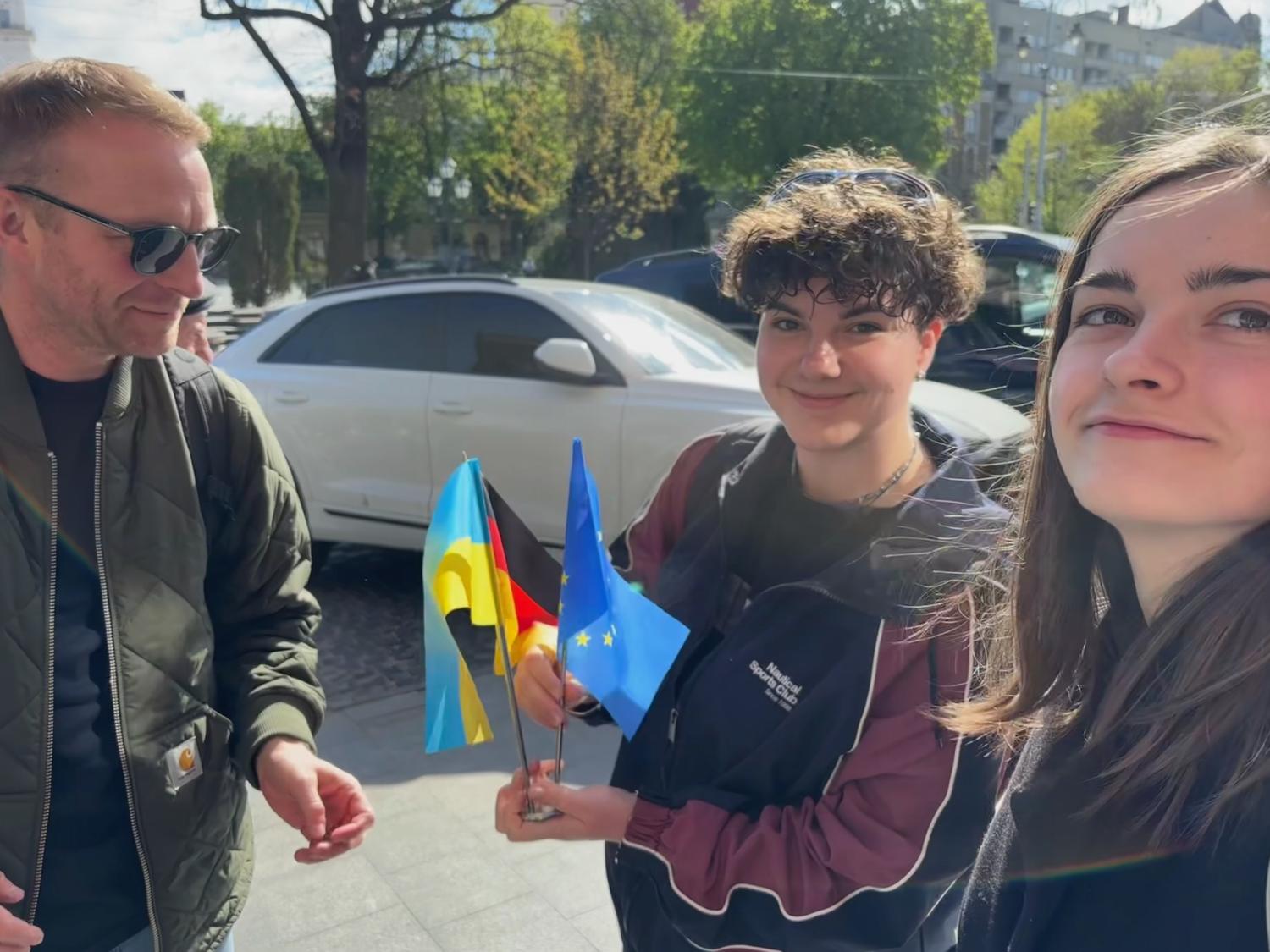
I think this is really groundbreaking. Our social scientists are studying how this build-up of a big research infrastructure in a rural area is working, and what doesn’t work. We know from astronomy that you need different specialisms – technicians, data analysts, experimentalists, theorists – all working together to solve big questions. During a recent trip to Ukraine with Valeriia Pinchuk (centre) and Mariia Seniak (right) from Ivan Franko National University of Lviv.
Many things, at least in big collaborations, are also social or psychological. Embedding big telescopes somewhere in a society is not as simple as just building them – there’s a context, there is a history. Natural sciences and the social sciences are usually so separated, but it really helps to have people who understand how they work together, and why some things may fail.
DZA and DESY are using the SKAO’s Table-Top Radio Telescope to train educators in Ukraine. How did this come about and what’s the long-term goal?
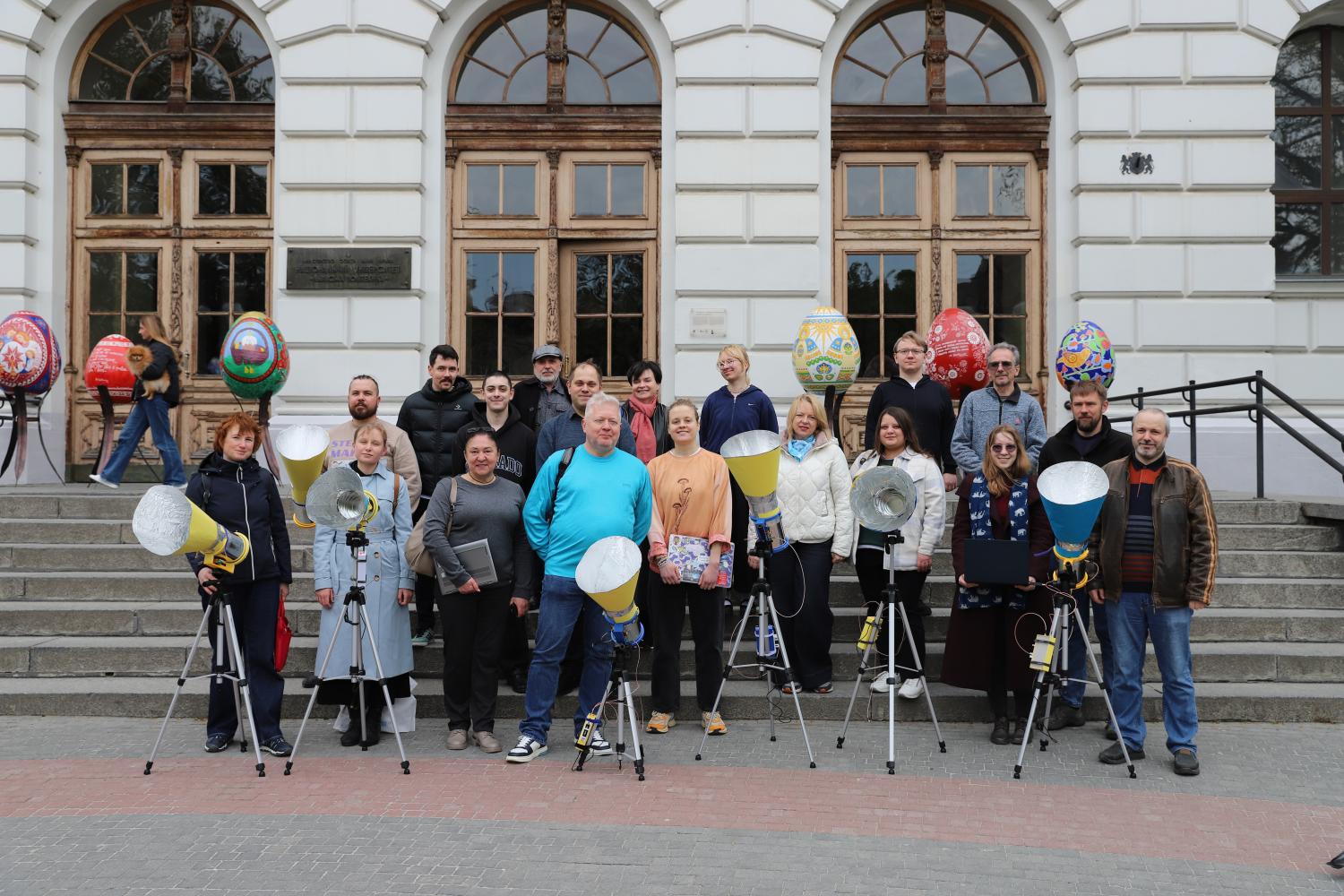
It started as a collaboration during the SKAO science meeting in Görlitz last year, where we held a school outreach event. We expanded it to partner schools in the north of the region, and now we are thinking about how to scale it up and also make it cheaper.
We always wanted to go international, and in Ukraine we were engaged in supporting a summer school already. There is a radio astronomy community and a very active astronomy teacher community there, so we thought we could do something good by providing teacher training workshops using the TTRT. It’s also a way for us to build our scientific connections to other countries.
We ran the first training in April and already got pictures from teachers in Odessa and Kyiv, where they taught their students using the TTRT and made observations of the Milky Way during the day. That was extremely rewarding to see, and also showed it’s not just a symbolic thing we did. We reached people and maybe also gave some hope. I had a little tear in my eye seeing that.
As we’re talking about the next generation, what advice would you give to young people about following a career in science?
Go with the flow. I wanted to do science, and always had a career in research in mind, but science is much more than that, so going with the flow and following my passion was what got me through all the bumps in the road. Also, look left and right, because there are many different ways you can work in science that may not be just doing research. I wish I had known that earlier. Do not be shy about asking for help, and be prepared for failure. It hurts, but it’s part of the job.
We’ve talked a lot about work, let’s spend a moment on how you fill your free time?
I don’t have so much free time. I’m super lucky to do what I love, so for me this distinction between work and private life is not so clear. I do enjoy listening to music, from metal to electronic, to jazz and the old 80s stadium rock bands. I love movies and TV series – sci-fi, of course! The Expanse is one of my favourite books and TV series. It’s not just that it’s close to the science, it’s also the human perspective and all the politics. And a guilty pleasure... trash TV! I like psychology, and in Temptation Island there is a moment in every season where people start to open up and be real. Plus, of course, I enjoy all the drama. I start to relate to people and their struggles. Now I’m analysing myself!
That’s the first time Temptation Island has featured in Contact. Let’s finish by looking ahead 10 years – what are your hopes for the impact DZA and the SKAO will have had by then?
For DZA, that we inspired a new generation of people, their parents, their grandparents, and that they see the value of science for society and for their lives. We won’t reach everybody, that’s clear. But helping to shape the identity of people by connecting them to astronomy, to space, that would be great. For the SKAO, I really hope that it’s taking off and that the younger generation start to get their hands on the data, and that we can start to talk about upgrades. Of course, by then there will have been many amazing discoveries – there’s no question about that.