





SKAO's telescope in South Africa 'comes alive' with first fringes milestone
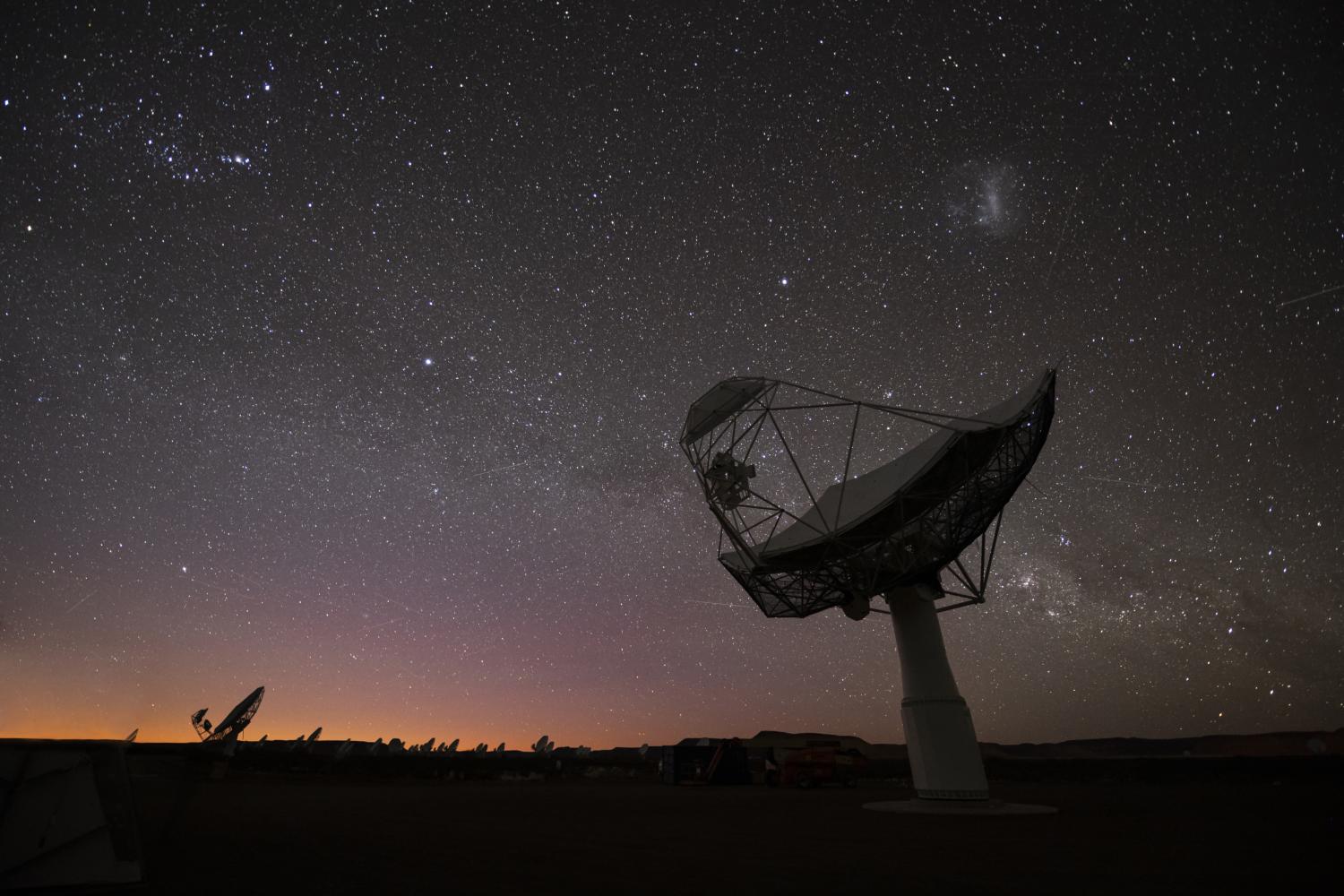
“This is the first true test that all our systems are working together, and that the SKA-Mid telescope is alive as a scientific instrument,” said SKAO Director-General Prof. Philip Diamond.
“Having each dish observe the sky individually is an achievement, but having them operate in concert as one telescope is a much bigger technical challenge, and our teams have now achieved that milestone.”
SKA-Mid, like its counterpart SKA-Low in Australia, is an array where many individual antennas are connected by optical fibre to act like one much larger telescope, equivalent in size to the distance between its furthest antennas. "Fringes” are obtained when signals received by two or more antennas are combined successfully.
Two of SKA-Mid's 15m-diameter dishes were used together to achieve the result, observing a radio galaxy estimated to be around 2.6 billion light years away.
“This source has been well studied so we know what the signal should look like, and that’s what we observed with this first fringes result. It confirms that all our hardware and software systems are working as we designed them to do, giving us confidence as we begin to commission the telescope,” said Dr Betsey Adams, SKA-Mid Commissioning Scientist.
“That includes seeing that the dishes can track across the sky in a coordinated way under the control of the telescope manager software, the receivers are being cooled to the required temperature of minus 250°C, the synchronisation and timing system is accurately timing signals from the different dishes to a billionth of a second, and the correlator is correctly processing and aligning the data.”
SKA-Mid now has seven dish structures assembled on site in the Northern Cape, with a further 12 on their way from the manufacturers CETC54 in China. When complete the telescope will comprise 197 dishes, including the integration of the existing MeerKAT radio telescope built and operated by the South African Radio Astronomy Observatory (SARAO).
Hardware and software for the SKA telescopes is being developed across the Observatory’s partner states.
“Starting the year with this news is a huge boost for the teams that have worked extremely hard to see it happen, including SKAO and SARAO colleagues, and our global and local partners who are contributing to the infrastructure, hardware and software for SKA-Mid,” said Ben Lewis, SKA-Mid Senior Project Manager.
“With all we’ve learned from these months building up to first fringes, we’re in a strong position to achieve our next milestone – the first image from a four-dish array within the next few months – and then to see SKA-Mid gradually grow in size and capabilities from there.”
Across the ocean in Australia, the SKA-Low telescope continues to grow at pace. Around 70 antenna stations, each comprising 256 antennas, have now been installed at Inyarrimanha Ilgari Bundara, the CSIRO Murchison Radio-astronomy Observatory on Wajarri Yamaji Country in Western Australia.
Last year its first image was released, using an early version of the telescope comprising four connected stations – 1,024 antennas – or less than 1% of the complete telescope.
As work continues to commission stations and integrate them into the array, planning is underway for the start of science verification activities with SKA-Low in 2027, when the first data will be released to the community for test observations.
Resources
You’ll find high resolution images and other video material in our media kit. Interviews with SKAO representatives can be arranged on request.
Media contacts
William Garnier
SKAO Communications Director
william.garnier@skao.int
Cassandra Cavallaro
SKAO Content and Media Lead
Cassandra.Cavallaro@skao.int